How to Protect Capital Without Holding Cash

Most investors default to cash when uncertainty rises. Reducing exposure and holding liquidity feels like the disciplined choice. Sometimes it is. But it is rarely the best way to protect capital over a full market cycle.

Cash carries a cost that rarely shows up on the same timeline as the comfort it provides. A portfolio that moved to 30% cash in early 2020 avoided much of the S&P 500's 34% drawdown between February 19 and March 23 of that year. It also missed much of the recovery. The index surged roughly 60% from its March low by November 2020, and the compounding that followed widened the performance gap for years afterward.

The real question for family offices, endowments, foundations, and UHNW individuals managing significant capital is not whether to take risk or avoid it. It is how to structure a portfolio that manages downside exposure without sacrificing the market participation that compounds wealth over time.

In brief

Protecting capital while staying invested requires structural tools — including dynamic position sizing, selective hedging, long/short flexibility, and leadership-quality screening — rather than the binary choice between full exposure and cash. The cost of cash is measured in missed compounding, which accumulates over time in ways that are rarely visible until years after the decision to step aside.

Why is cash a more expensive hedge than it appears?

The case for holding cash during uncertainty seems straightforward: preserve capital, reduce volatility, wait for clarity. But this framing treats risk as a single variable — the chance of loss. In practice, risk has two dimensions: the risk of losing capital and the risk of failing to grow it.

Cash eliminates the first and guarantees the second.

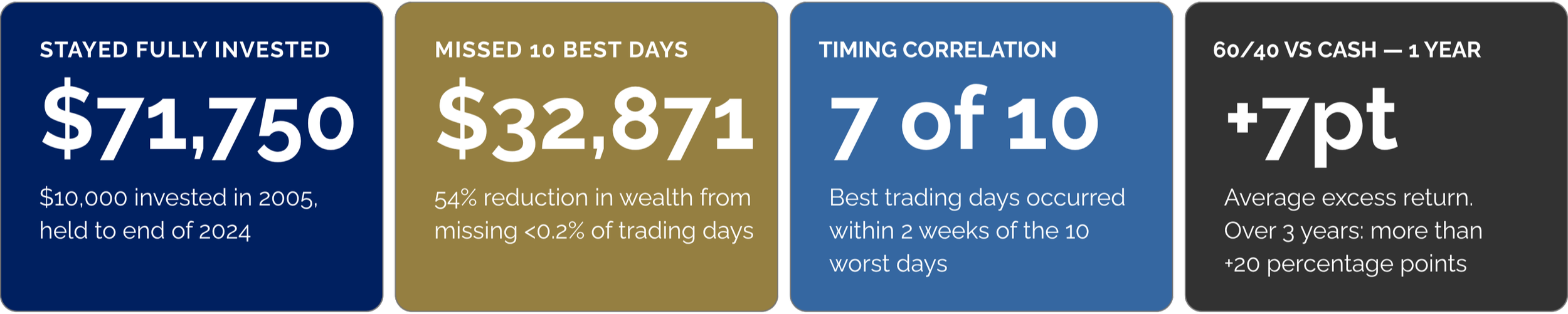
JPMorgan Asset Management's Guide to the Markets tracks what happens to a hypothetical $10,000 investment in the S&P 500 depending on whether the investor stays fully invested or misses the strongest recovery days. Their data shows that $10,000 invested in 2005 would have grown to approximately $71,750 by the end of 2024 if the investor stayed fully invested. Missing just the 10 best trading days over that period would have cut the ending value to roughly $32,871. That is a 54% reduction in total accumulated wealth from missing fewer than 0.2% of trading days. Missing the best 60 days would have left the investor with less than the original $10,000.

Stayed fully invested
$71,750
$10,000 invested in 2005, held to end of 2024
Missed 10 best days
$32,871
54% reduction in wealth from missing <0.2% of trading days
Timing correlation
7 of 10
Best trading days occurred within 2 weeks of the 10 worst days
60/40 vs cash — 1 year
+7pt
Average excess return. Over 3 years: more than +20 percentage points
The structural cost of stepping out
$10,000 in the S&P 500 — fully invested vs. missing the best days (2005–2024)
Seven of the 10 best trading days occurred within two weeks of the 10 worst days. Stepping out to avoid the worst almost guarantees missing the best.
Stayed fully invested Missed some best days Ended below original $10,000
Source: JPMorgan Asset Management, Guide to the Markets. $10,000 initial investment, S&P 500 total return, 2005–2024.

The numbers illustrate a structural problem, not just a timing risk. Seven of the 10 best trading days over that period occurred within two weeks of the 10 worst days. Stepping out to avoid the worst days almost guarantees missing the best ones. The implication for portfolio construction is that capital protection strategies built around exiting and re-entering the market face a structural disadvantage that compounds over time.

A 60/40 portfolio of equities and government bonds has outperformed cash more than 70% of the time over any one-year horizon and in the vast majority of rolling three-year periods, with average excess returns above cash of 7 percentage points over one year and more than 20 percentage points over three years, according to JPMorgan research.

For family offices managing multigenerational wealth, endowments supporting annual distributions, and foundations funding ongoing programs, missed compounding is the more consequential risk. The question becomes practical: how do you reduce downside exposure without giving up the market participation that produces long-term returns?

How is capital protection structured without liquidating positions?

Protecting capital while staying invested is a structural challenge, not a timing decision. The following mechanisms work together to reduce downside exposure while maintaining the portfolio's ability to participate in rising markets. What ties them together is the same discipline: each one replaces a reactive, emotion-driven decision with a pre-built analytical framework.

Capital protection framework
Six structural tools — how Eagle Talon structures protection
Each mechanism replaces a reactive, emotion-driven decision with a pre-built analytical framework.
1
Dynamic position sizing
Position sizes adjust based on conviction and market conditions, not based on fear. When analytical confidence in a holding is high and valuation is attractive, the position is larger. When conviction is lower or valuation is stretched, the position size shrinks. This differs fundamentally from reducing all positions by the same percentage, which treats every holding as equally risky regardless of its specific characteristics.
2
Selective hedging through options
Options are a precision tool for managing specific risks without liquidating positions. A put option on a concentrated position protects against a defined downside scenario while keeping the position intact to capture upside. The cost of the hedge is explicit and bounded, unlike the implicit and open-ended cost of selling the position entirely. Cambridge Associates found that systematically buying put options eroded almost two-thirds of equity returns over nearly thirty years. Selective hedging, by contrast, targets specific positions where the risk is identifiable and the cost of protection is justified.
3
Long/short flexibility
The ability to hold short positions alongside long ones reduces the portfolio's overall sensitivity to market direction. A carefully selected short position — typically in a company where leadership quality has deteriorated or capital allocation discipline has weakened — can generate returns in declining markets. Those returns offset losses in long positions. This flexibility means overall exposure adjusts without liquidating high-conviction holdings.
4
Cash as deliberate optionality
When cash is held, it should be held with a specific deployment thesis, not as a general hedge. Optionality cash is available to deploy into dislocations — into positions that become available at attractive valuations during market stress. The distinction between defensive cash (held out of fear) and optionality cash (held for deployment) is worth maintaining explicitly.
5
Leadership-quality screening as the primary risk filter
The most effective form of downside protection is owning companies led by management teams that navigate difficulty well. CEOs who maintain discipline in how they allocate capital when revenue growth decelerates, who resist the temptation to pursue acquisitions that mask organic weakness, and who hold their course despite short-term market pressure typically lead businesses that emerge stronger from difficult periods. We use leadership assessment as a primary risk management filter, not just an investment selection tool.
6
Systematic income generation through options
We opportunistically sell calls and puts against core positions, functioning as a market maker buying and selling around the edges of holdings we know well. During choppy, range-bound markets, this generates consistent income that compounds alongside the portfolio's long-term returns. It also reinforces disciplined behavior: selling calls at prices where we would be willing to trim and selling puts at prices where we would be willing to add.
"The quality of decision-making at the top of a company is the single most underpriced variable in institutional investing."
— Eagle Talon Partners

What behavioral patterns typically undermine capital protection efforts?

Understanding these tools is necessary. Applying them when markets are falling sharply is harder. Three behavioral patterns tend to undermine capital protection, and each carries a hidden cost.

Behavioral patterns that undermine protection
Three traps — each with a hidden compounding cost
Understanding these is necessary. Applying the structural tools when markets are falling sharply is harder.
Selling based on price, not thesis
When a high-conviction position declines 15% or 20%, the instinct to sell is strong. But if the investment thesis is intact — if the leadership team is still executing and the capital allocation framework is unchanged — selling locks in a temporary loss and eliminates the position's participation in recovery. Capital protection means having the analytical framework to distinguish between a price decline that reflects deteriorating fundamentals and one that reflects temporary market stress.
Hidden cost
Locks in a temporary loss and eliminates participation in recovery
Hedging after volatility has already increased
The most common hedging mistake is purchasing protection after option premiums have already risen — when the cost of hedging is highest. Effective hedging programs are maintained through calm periods when the cost is low, not initiated during panic when the cost is prohibitive.
Hidden cost
Pays the highest premium at the worst moment — protection when it costs most and helps least
Treating all risk as equivalent
A 15% decline in a company with strong leadership and improving fundamentals is a different situation than a 15% decline in a company where the CEO is making increasingly aggressive capital allocation choices. Treating both the same sacrifices the position with the highest expected recovery while maintaining the one with the highest fundamental risk.
Hidden cost
Exits the best recovery candidate; holds the position with the highest fundamental risk

Which signals should shape portfolio exposure decisions?

Rather than watching market direction, we focus on signals that indicate when and how to adjust exposure.

Portfolio exposure signals
Four signals to watch — not market direction
These are the indicators that actually tell you when and how to adjust. Market direction is noise; these are signal.
Changes in leadership behavior at portfolio companies

When a CEO's tone on earnings calls shifts from specific to vague, when capital allocation priorities change without clear explanation, when execution becomes inconsistent — these behavioral signals often precede the financial deterioration that drives stock price declines. Identifying these shifts early is the most effective form of capital protection available to fundamental investors.

Volatility levels and hedging costs

The cost and effectiveness of hedging tools change significantly across different market environments. Maintaining hedging programs when volatility is low and adjusting them when volatility spikes is a structural discipline, not a timing decision.

Conviction levels across the portfolio

Regular reassessment of analytical conviction — not just price performance — determines whether position sizing should adjust. A position where conviction has declined warrants reduction regardless of whether it is showing a gain or loss.

Emerging dislocations as deployment opportunities

The most attractive entry points tend to emerge during periods of market stress. Having optionality cash available and a pre-built watchlist of high-quality companies at defined entry points turns market dislocations from threats into opportunities.

Investment professionals reviewing portfolio strategy

Protection is a structure problem — not a prediction problem.

The investors who have historically preserved and grown capital through volatile periods were not the ones who predicted market direction correctly. They were the ones whose portfolio structure could absorb the surprises they did not predict.

Eagle Talon Partners builds portfolio structures around leadership assessment, capital allocation discipline, and decision-making patterns — not around forecasting market direction.

Schedule a confidential discussion

How capital protection connects to long-term portfolio construction

Capital protection is about maintaining a portfolio structure that can absorb setbacks, act on opportunities, and compound capital through full market cycles.

For family offices, endowments, and foundations evaluating how to allocate capital in uncertain markets, the structural approach to protection is more reliable than the timing approach. The investors who have historically preserved and grown capital through volatile periods were not the ones who predicted market direction correctly. They were the ones whose portfolio structure could absorb the surprises they did not predict.

"What makes an investment strategy durable over time is the same set of structural disciplines that protect capital in the short term: dynamic sizing, selective hedging, leadership screening, and the analytical framework to distinguish temporary price declines from genuine deterioration. Applied consistently, not reactively."
— Eagle Talon Partners

We build portfolio structures that protect capital without predicting markets

Eagle Talon Partners assesses leadership quality, capital allocation discipline, and decision-making patterns as forward signals on investment outcomes. If you're thinking about how to structure your portfolio for protection and participation, we're always open to a thoughtful conversation.

Schedule a Confidential Discussion