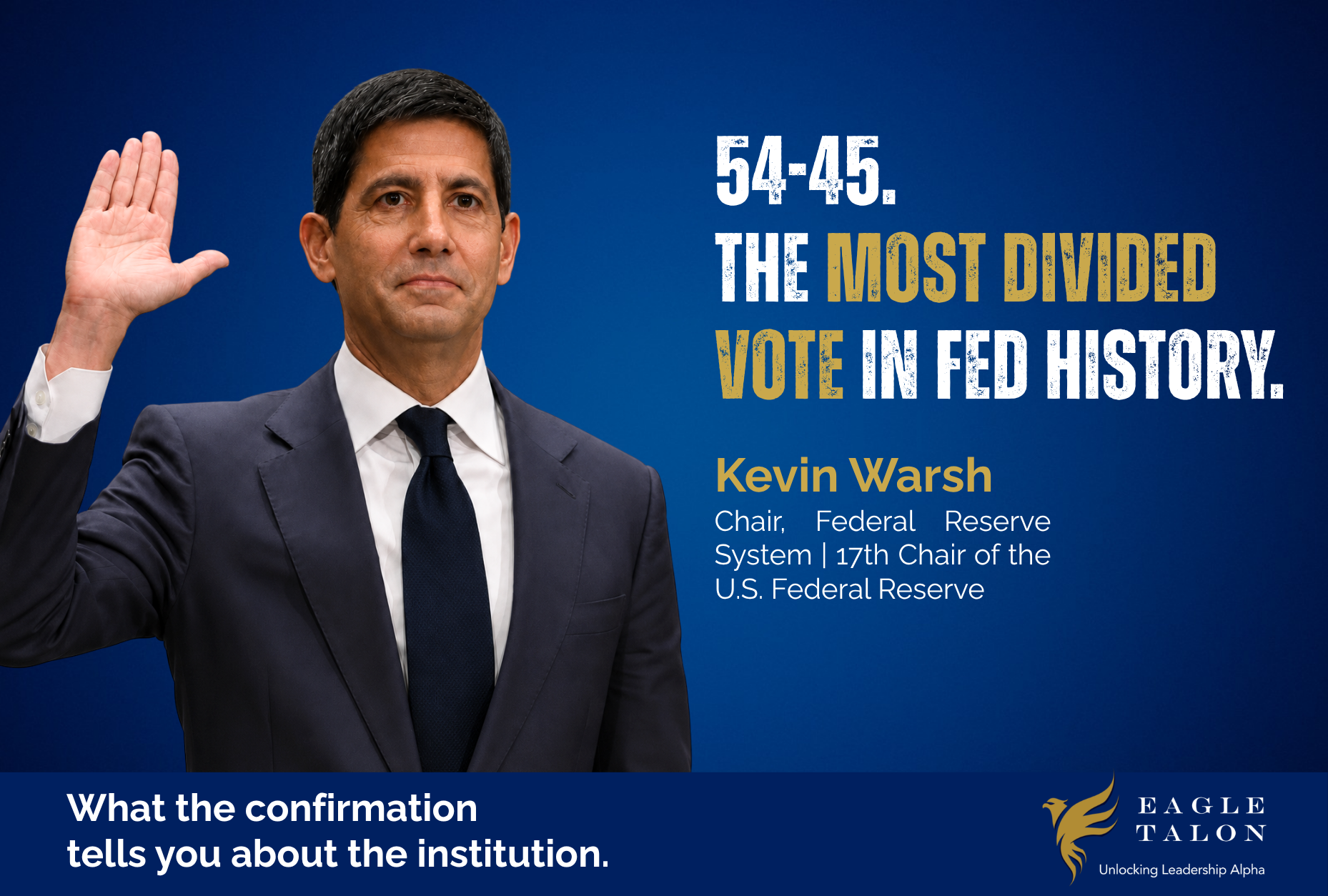
54-45. The most divided confirmation vote in modern Federal Reserve history
Note: This image contains AI-generated elements.
54-45. The most divided confirmation vote in modern Federal Reserve history.
Kevin Warsh was confirmed almost entirely along party lines. Only one Democrat, Pennsylvania's John Fetterman, crossed over. He becomes the 17th Fed Chair when the central bank's independence faces more political pressure than at any point in the last four decades.
His biography reads like preparation for exactly this moment. Stanford. Harvard Law. Six years at Morgan Stanley in mergers and acquisitions. The Bush White House as special assistant for economic policy. Then the Fed Board at 35, the youngest governor in the institution's history. He was in the room during 2008.
He left in 2011. Voluntarily. He opposed the second round of quantitative easing, a $600 billion bond-buying program. His argument: it would create dangerous dependency on central bank liquidity. At the precise moment the institution committed to it, he walked away.
That kind of conviction costs something.
He spent fifteen years outside that building arguing publicly that the Fed had overreached. In his confirmation testimony, he was direct: "The Fed must stay in its lane."
Now he's in the chair. Powell stays on the Board as a Governor, voting on rates until January 2028. The predecessor is still at the table. And the White House is watching.
Warsh has the institutional knowledge and the conviction. The question is whether he has the patience. His first FOMC meeting as Chair is June 16-17.
The leaders who navigate transitions like this well don't open with ideology. They open with credibility, earned quietly, before attempting to change anything.
Will Warsh spend his first 90 days building consensus on the FOMC? Or will fifteen years of public criticism drive him to act before he's earned the room's trust?
🔗 Source: Kevin Warsh Wins Senate Confirmation as the Next Federal Reserve Chair