Founder Returns Are Rarely About Nostalgia
Note: This image contains AI-generated elements.
Founder Returns Are Rarely About Nostalgia
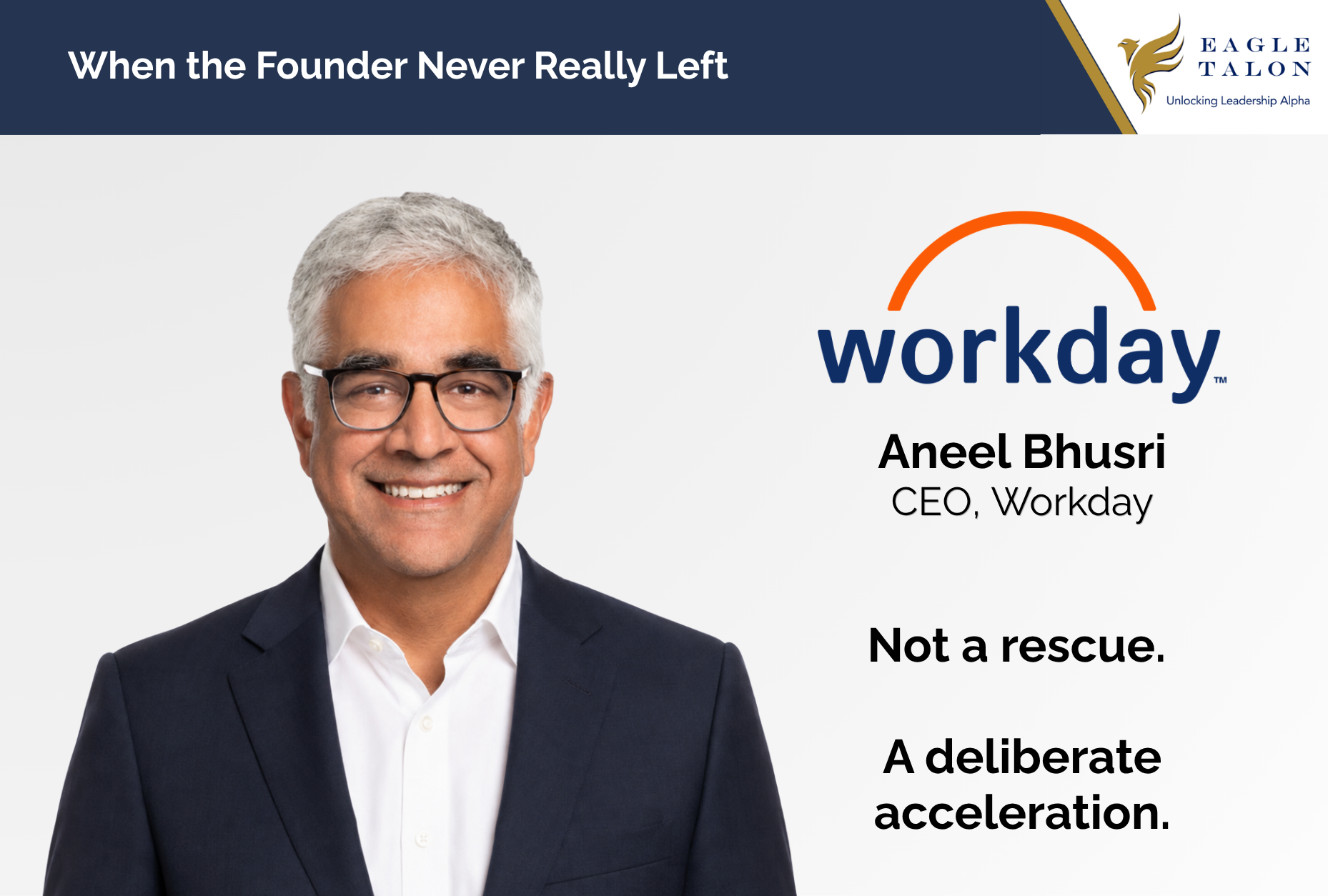
In February, Workday brought co-founder Aneel Bhusri back as CEO, replacing Carl Eschenbach as the company pushes harder into AI. The change was effective immediately. The stock fell roughly 5% on the news.
But the backstory here matters more than the headline.
Bhusri wasn't a founder pulled back from the outside. He'd been serving as executive chairman since 2024 — already inside the governance structure, with board authority, watching conditions closely. That makes this less a rescue than a deliberate acceleration.
The market backdrop adds important context. Workday shares had declined 17% in the prior year and were down an additional 25% year to date at the time of the announcement — a combined drop of roughly 38% over that span. Softer enterprise tech budgets, layoffs, and an increasingly urgent AI repositioning all set the stage.
When a founder in the chair role steps back into the CEO seat, the real question is:
➤ Does it compress decision-making and restore strategic coherence?
➤ Or does it signal the board concluded the bench wasn't deep enough to run the next chapter without original vision at the top?
On Eschenbach's exit: he leaves the board entirely and moves to a strategic advisor role. There's no governance seat, no vote, no structural oversight. But Bhusri retains access to Eschenbach's institutional knowledge and operational context if he needs it — on his terms, not Eschenbach's. That's a cleaner handoff than a retained board seat, and it keeps the balance of authority exactly where the board intended it.
Founder comebacks can energize a company. They can also reveal how much the business still depends on original conviction when conditions get harder.
When a founder returns from the chair seat rather than from the outside, does that change your read on whether it's a reset — or a recognition that the transition never fully took?
🔗 Source: Workday Names Co-Founder Aneel Bhusri as CEO in AI-Driven Shift