Netflix hit a 52-week low on a quarter it didn't miss
Note: This image contains AI-generated elements.
Netflix hit a 52-week low on a quarter it didn't miss.
Q2 revenue was $12.6 billion, up 13% year over year. Operating margin held at 33.4%. Earnings beat, revenue met. What the market sold was the Q3 forecast: $12.86 billion, about 12% growth, below the $13 billion consensus.
The forecast moved the stock. The business didn't.
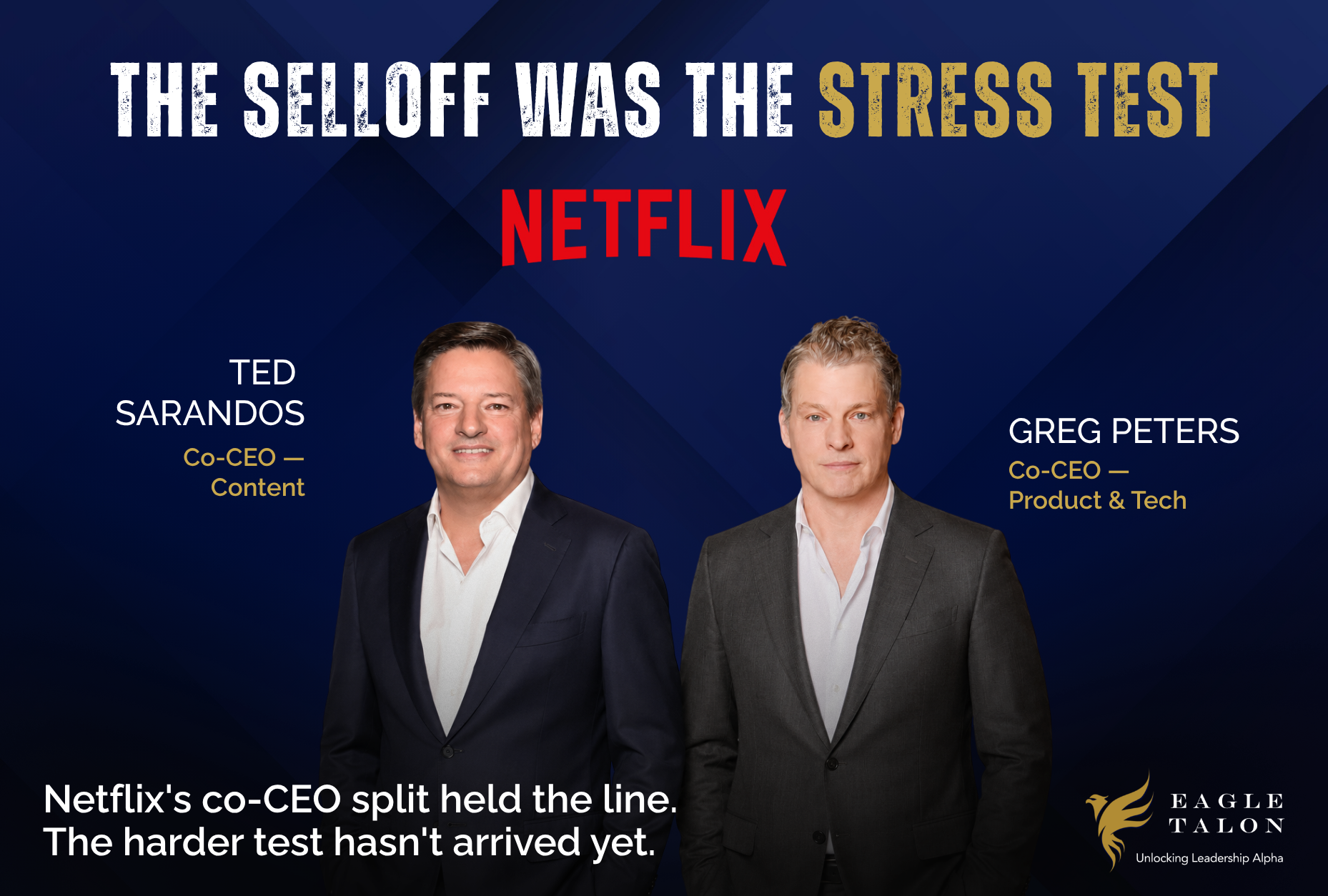
The two co-CEOs handled the analyst pushback on the Q3 number cleanly, and it was encouraging to watch.
Ted Sarandos owns content. Greg Peters owns product and technology. No overlap over who answers what. When analysts challenged the Q3 outlook, Peters called it "quarter-to-quarter choppiness" and held the full-year range firm. Netflix narrowed full-year 2026 guidance to $51 to $51.4 billion, still double-digit growth. Neither co-CEO blinked.
The clean split let each answer his own lane without stepping into the other's. That structure, not the composure, is the governance signal.
The model has been tested: the password-sharing crackdown, the ad-tier launch, the live-sports push, and the collapsed Warner Bros. Discovery deal that handed Netflix a $2.8 billion breakup fee when WBD took a higher Paramount bid. It has held because the domains don't blur: Sarandos owns what's on screen, Peters how it reaches the viewer.
J.P. Morgan is still testing a co-president structure. Oracle handed its co-CEOs a $638 billion backlog. Netflix has already answered the question those boards are still asking. Co-leadership works when domains are genuinely separate and accountability clear, and fails when they aren't.
At Eagle Talon, we test co-leadership structures with the question: are the domains split as cleanly as Netflix's? When they are, it may be the most durable governance decision a board makes. When they aren't, it's a hidden risk.
Netflix's co-CEOs didn't blink on a 52-week-low day. But that steadiness hasn't yet met the moment when content and product pull against each other. Does holding the line today validate the structure, or postpone its real test?