NVIDIA Bought Equity in the Capacity It Wants Corning to Build
Note: This image contains AI-generated elements.
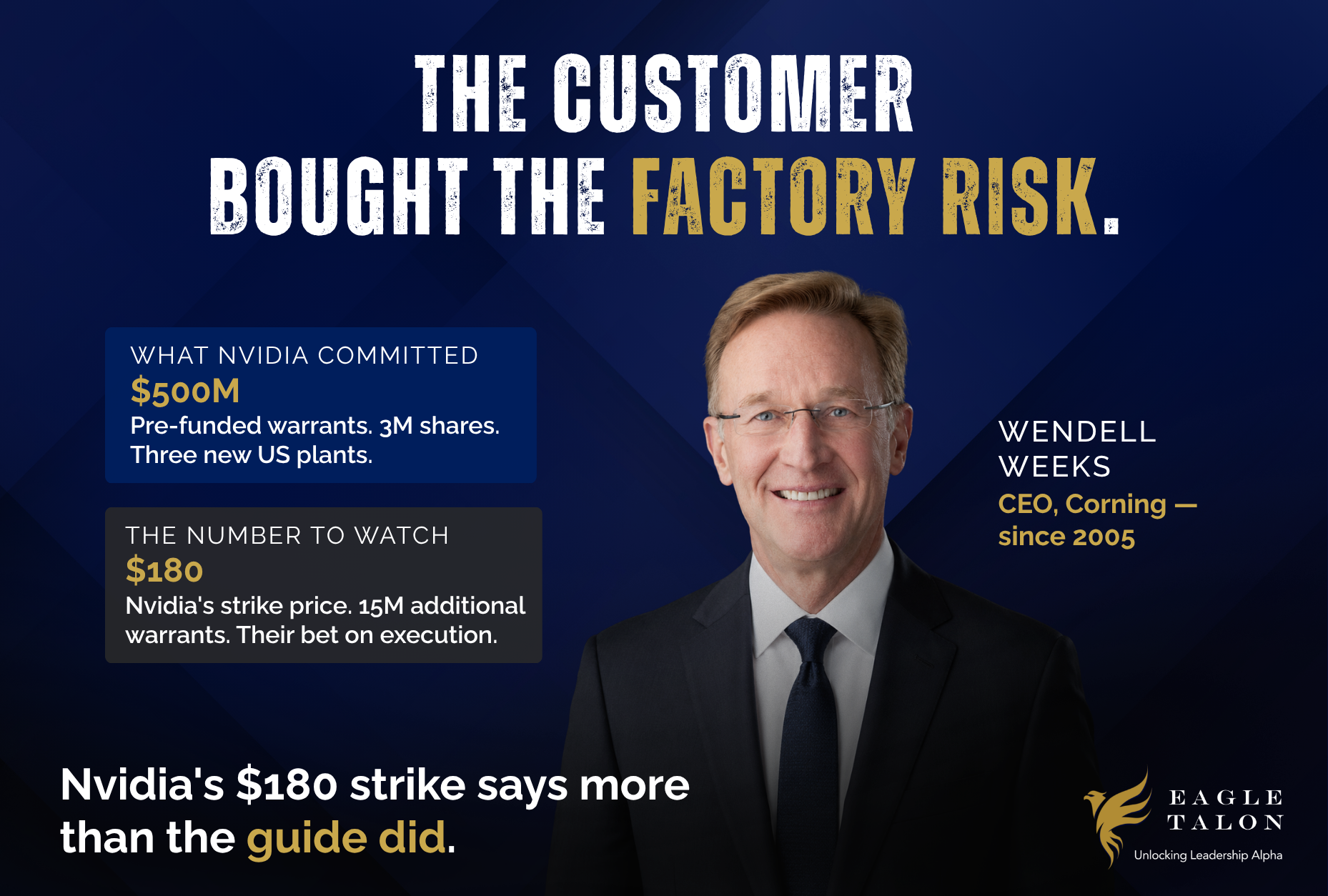
NVIDIA bought equity in the capacity it wants Corning to build.
The second quarter, reported July 28, was the first test. Core sales of $4.74 billion, up 17%, against $4.63 billion expected. Core earnings of $0.78 a share, up 30%. Optical Communications, the fiber and connectivity business, did $2.07 billion, up 32%. Enterprise networks within that segment grew 65%.
The stock fell 16% intraday.
The third-quarter guide is where the reaction turned. Revenue of $4.9 to $5.0 billion topped out at the $4.99 billion consensus rather than clearing it. A stock that had more than doubled year to date carried expectations no in-line revenue range could support.
Wendell Weeks has run Corning Incorporated since 2005. He read where the physical constraint in the AI buildout would land, and committed capacity before the market agreed.
The May 6 Nvidia agreement shows what that cost: three new US plants in North Carolina and Texas, and a tenfold increase in optical connectivity capacity. Nvidia paid $500 million up front for pre-funded warrants on 3 million shares, and holds warrants for 15 million more at a $180 strike. Total potential investment if all warrants are exercised: $3.2 billion.
Nvidia is funding capacity it will not own, taking equity risk on Corning's execution. Customers rarely put capital behind a supplier's factories. The $180 strike prices what this one expects.
At Eagle Talon we test capital commitment against strategic claim — then who absorbs the loss if demand slips, and what a leader signed rather than announced. Weeks clears all three.
Corning answered with dated targets, not reassurance: $20 billion annualized by the end of 2026, $30 billion by end of 2028, $40 billion by 2030. Concentration risk cuts the other way. Optical Communications was roughly 44% of core sales, and those targets assume that share keeps compounding.
Which tells you more about Weeks over the next two years: the $180 strike Nvidia negotiated, or the $40 billion Corning published?