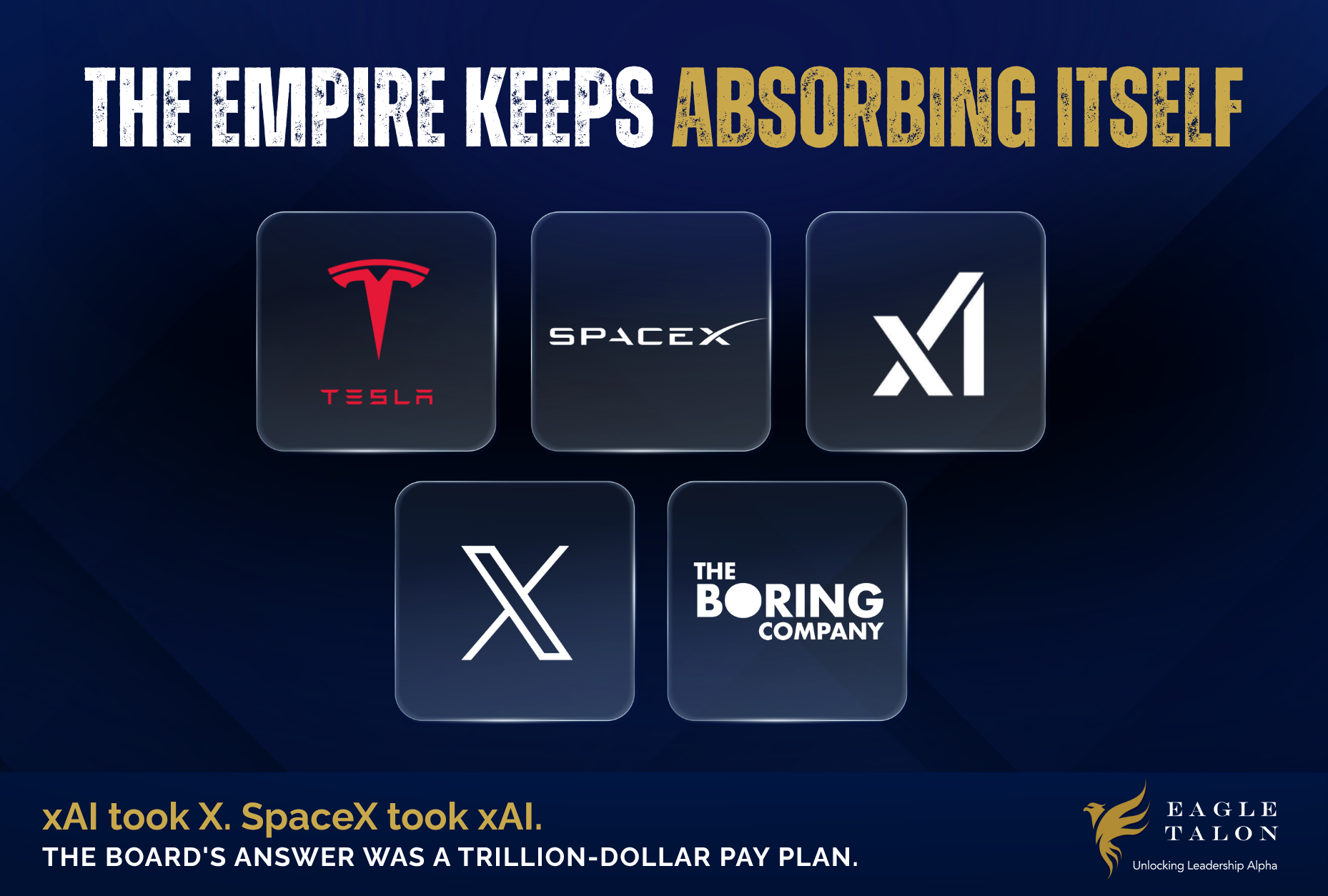
The empire keeps absorbing itself
Set aside whether Elon Musk is capable. He is. The open question is whether Tesla's board is governing the one risk it can't diversify away: his attention.
Tesla is worth roughly $1.6 trillion. It's working through softening electric-vehicle demand, brand damage in Europe tied to Musk's politics, and a robotaxi rollout that needs regulatory clearance one market at a time. Each of those needs a CEO's full focus.
Musk's focus is spread across an empire that keeps folding into itself. xAI bought X. SpaceX then bought xAI. What used to look like separate companies is now one interlocking structure, with Tesla sitting inside the web. Tesla's own filings show $573 million in transactions among Musk-controlled entities last year, and its $2 billion investment in xAI converted into SpaceX stock.
So the governance question runs deeper than bandwidth. It's whether the board can still tell where Musk's interests end and Tesla's begin.
The board's answer has been to tie him down tighter. In November, shareholders approved a pay package worth as much as $1 trillion over a decade. After moving to Texas, Tesla now requires an investor to hold 3% of the company, about $30 billion, before suing over a governance breach. Only Musk himself clears that bar.
At Eagle Talon, we treat a CEO's attention as a scarce asset and watch how the board protects it. Tesla's board is busy managing its relationship with Musk while the related-party and attention risk it should be governing sits in plain view.
With Musk's companies merging into one another, what would actually force this board to draw a hard line between his interests and Tesla's, and which large shareholder makes that demand first?
🔗 Source: Tesla Made $573 Million in Sales From SpaceX and xAI Last Year