BP deleted its green business from the org chart, and almost no one noticed the timing
Note: This image contains AI-generated elements.
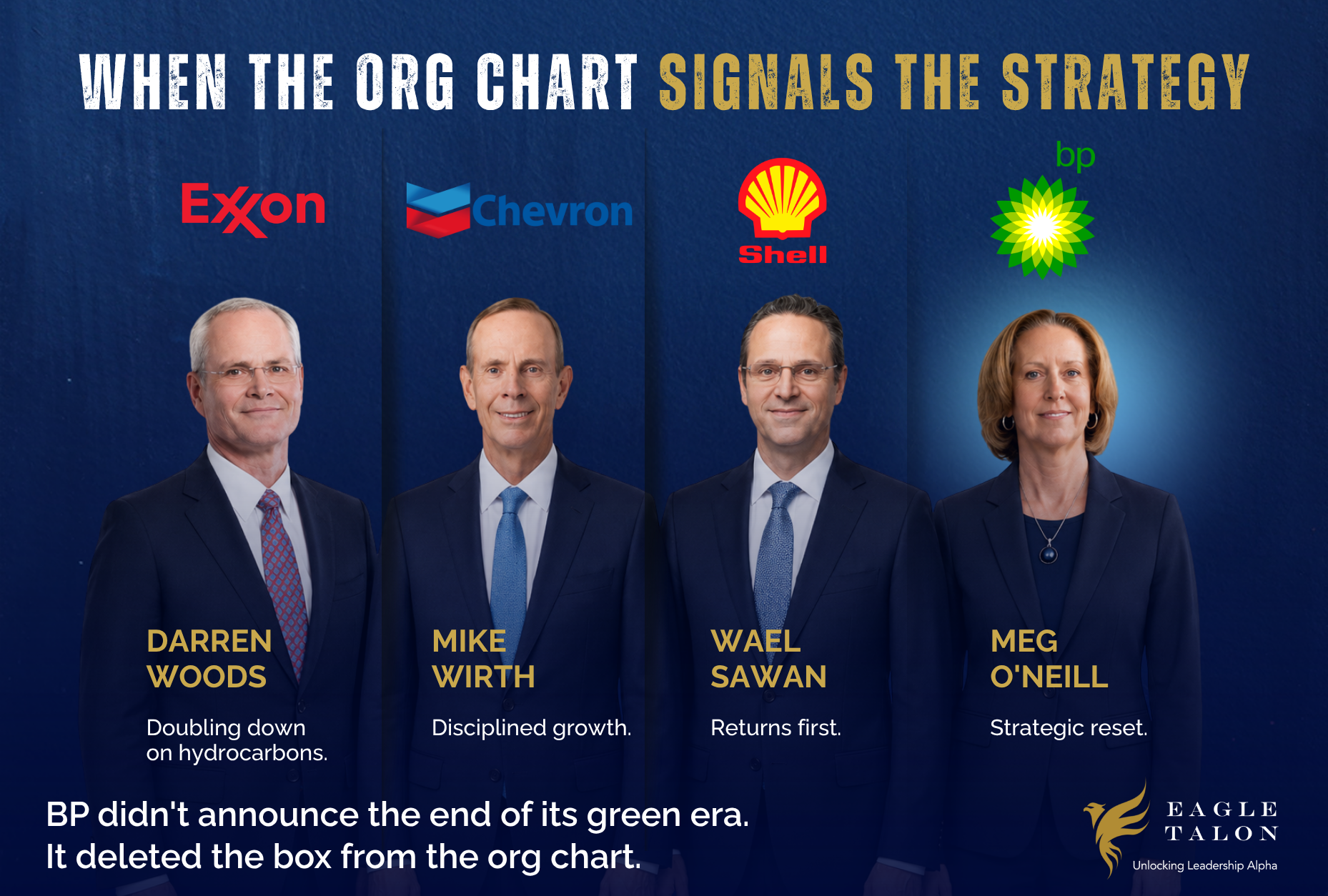
BP deleted its green business from the org chart, and almost no one noticed the timing.
Seventy days into the job, new CEO Meg O'Neill folded bp's three segments into two: Upstream and Downstream. On July 1, the standalone Gas and Low Carbon Energy unit will disappear. Solar, wind, and carbon capture will survive only as a capital-light line inside the Technology function. The green branding is gone, and the retreat is now built into the structure.
O'Neill came from running Woodside Energy, Australia's largest oil and gas producer. The board hired an operator, not a transition evangelist, and it hired the background that matches where it wants the company to go.
The timing is what I keep coming back to. Two weeks before the restructuring, BP's board removed its own chairman, Albert Manifold, for what it called serious concerns about his conduct. Manifold was the chairman who pushed BP back toward oil and gas, and who championed O'Neill as the right leader for that direction. So she is now executing the strategy her main board sponsor set, weeks after that same board forced him out.
That leaves O'Neill with two real risks. The first is that her strategy is young. She set a decisive oil-and-gas direction before steering BP through a full commodity-price downturn, and energy prices are cyclical. The second is governance. A board that has churned through three CEOs since 2020 and just removed a chairman for misconduct cannot credibly promise stability.
At Eagle Talon, we read the decision behind the restructuring, not the press release. O'Neill built her career running an oil and gas pure-play. Now she is reshaping BP into one, and moving quickly.
Is she the right leader for that mandate, or does BP's deeper risk sit in a boardroom she doesn't control?
🔗 Source: BP's New CEO Meg O'Neill Rips Up the Energy Giant's Playbook—and the 'Green' Era With It