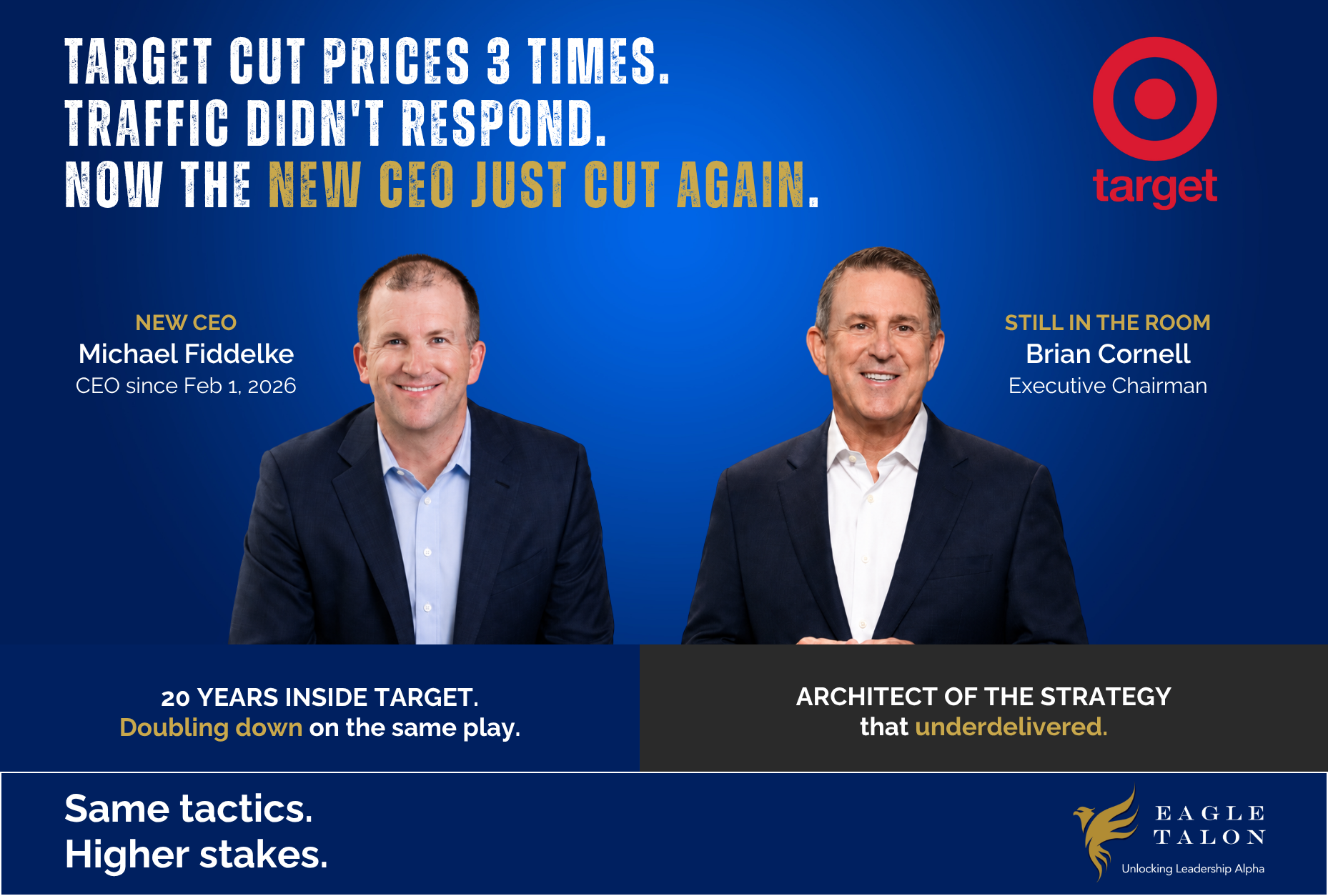
Target has now cut prices three times in ten months. Traffic hasn’t responded once
Note: This image contains AI-generated elements.
Target has now cut prices three times in ten months. Traffic hasn’t responded once.
Michael Fiddelke took over as CEO on February 1, succeeding Brian Cornell, who moved to Executive Chairman – a formal governance seat with ongoing authority, not a consulting arrangement. Fiddelke is an internal promotion. He spent 20 years at Target across merchandising, finance, and operations before becoming COO.
The board chose continuity. That choice carries a specific risk: Fiddelke built his career inside the same organization whose strategy produced four consecutive quarters of falling traffic and a 3.8 percent comp sales decline in Q2 2025.
His first major decision was to double down on the approach that already came up short. Beginning in May 2024, Target cut prices on roughly 5,000 items then another 2,000 by October, and saw almost no traffic response. And shares fell 21 percent after the Q3 2024 earnings miss.
Fiddelke’s answer: 3,000 more cuts in March 2026, ranging 5 to 20 percent across apparel, home goods, and essentials.
At the March 3 Investor Day he outlined $6 billion in capital spending, AI-driven supply chain improvements, faster delivery, and guided adjusted operating income margins to 4.8 percent for 2026 – up 20 basis points year-over-year. The stock is up roughly 37 percent year-to-date, from about $98 to around $130.
But that move reflects confidence in the plan and the leadership transition, not confirmed results from the latest round of cuts.
Two risks come with that mandate. First, the strategy is a scaled-up version of what underdelivered twelve months ago, and Cornell’s continued presence as Executive Chairman means the architect of the prior approach still has structural influence over the person executing the next iteration. Second, Fiddelke also restructured executive leadership – Cara Sylvester as chief merchandising officer, Lisa Roath as COO – which means new leaders in key seats during a period when execution speed matters most.
What to watch: whether the spring cuts produce a measurable traffic inflection by Q2 2026 earnings. If three rounds of price reductions and $6 billion in capital spending haven’t changed the trajectory by then, the question shifts from strategy to whether this leadership team sees something in the consumer data that the results haven’t confirmed.
Where do you draw the line between a CEO earning runway with a credible plan and a board giving a new leader permission to run the same play one more time?