Two tech CEOs. One chose his exit. The other had it chosen for him
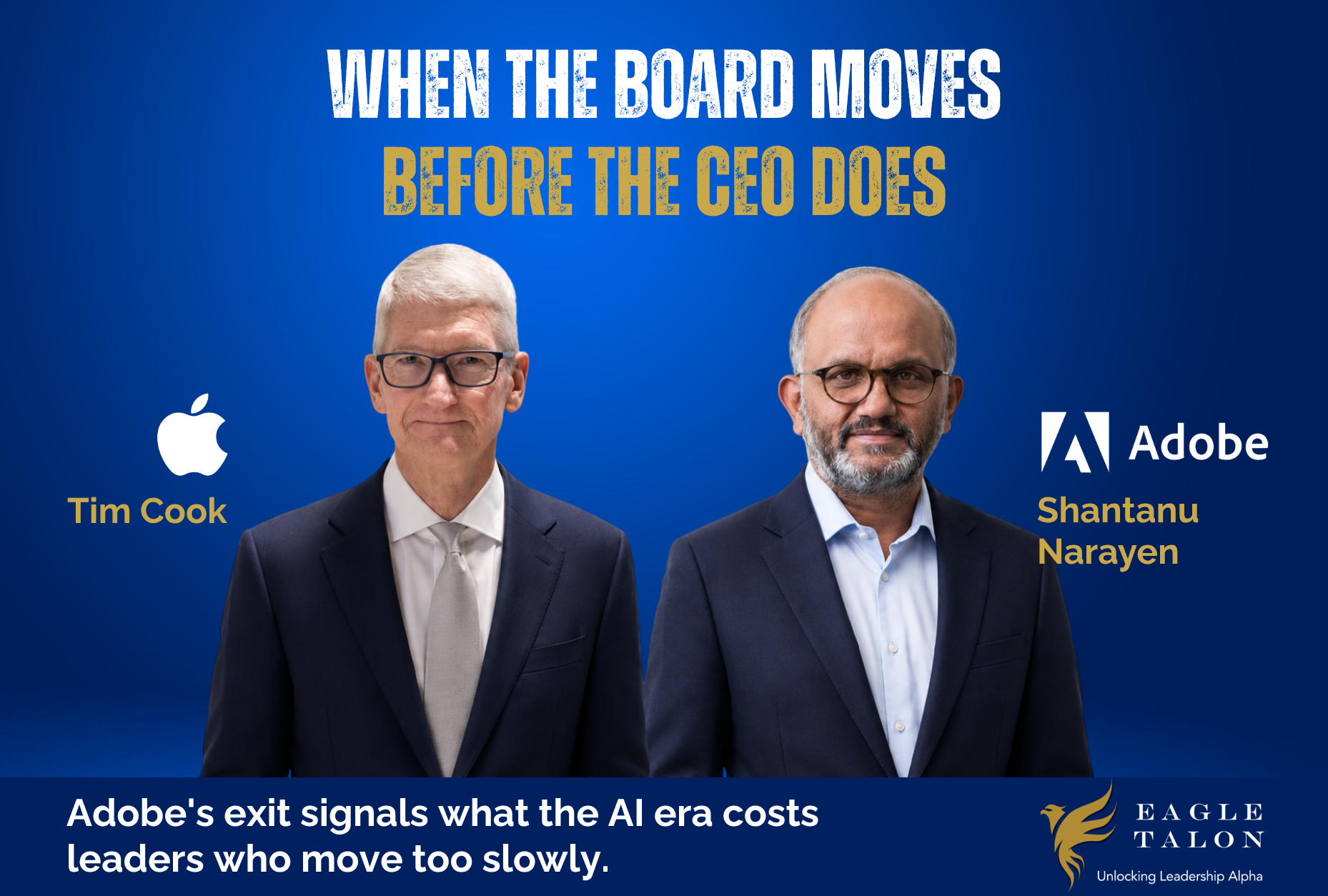
Note: This image contains AI-generated elements.
Two tech CEOs. One chose his exit. The other had it chosen for him.
Tim Cook announced in April he'll step down as Apple CEO effective September 1, becoming Executive Chairman. Under his leadership, Apple grew from roughly $350 billion in market capitalization to $4 trillion. He named John Ternus, Apple's head of hardware engineering, as his successor and defined the timeline.
Choosing a hardware architect over a services executive signals where Apple sees its next cycle. With AI living at the chip and device layer, this is a bet on the physical infrastructure underneath every software decision Apple makes for the next decade.
Five weeks earlier, Adobe CEO Shantanu Narayen announced he would step down after 18 years once a successor is named. He'll stay on as Board Chairman. Adobe's stock had fallen roughly 30% year-to-date by end-April, with AI competition appearing to outpace Adobe's own AI monetization. The timing suggests a departure shaped as much by investor impatience as personal choice.
The contrast is instructive. Narayen led Adobe's transformation from packaged software to cloud subscriptions. That track record is real. But when the AI cycle accelerated, the gap between spending and revenue widened faster than investor patience allowed.
At Eagle Talon, we map every CEO transition against a specific question: did the leader read the next cycle early enough to shape the succession on their own terms?
Cook did. He identified the hardware-to-AI shift, positioned Ternus, and chose his moment. Narayen may have read the cycle correctly but moved too slowly for a market that had already repriced the timeline.
The implication extends beyond Adobe. Boards in 2026 are recalibrating how much runway "we're investing for the future" actually buys.
If Adobe names an external, AI-native successor, that will confirm the board concluded its internal bench couldn't close the gap fast enough. That's the next signal worth watching.
🔗 Source: Adobe CEO to Step Down in Face of Investor Concerns Over AI